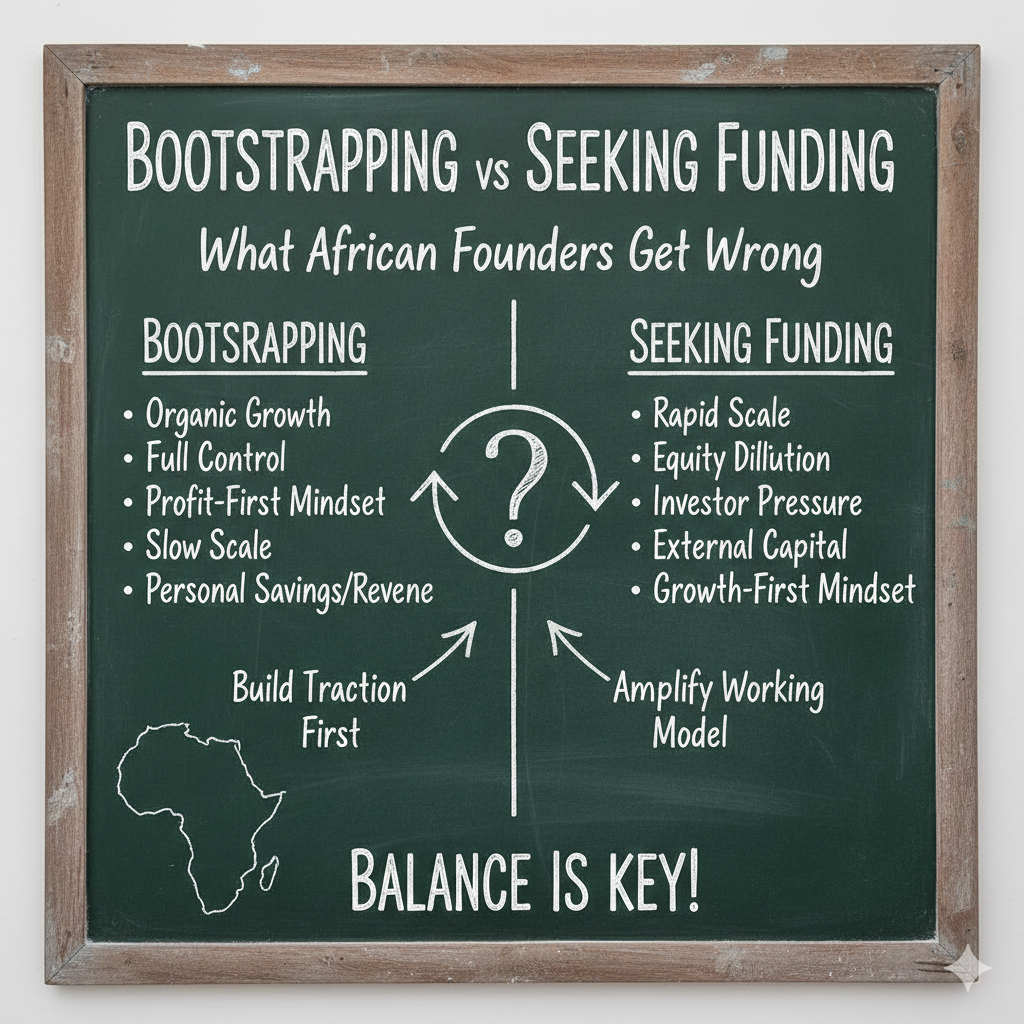
“I need funding to start.” It’s the most common and most dangerous phrase in the African startup ecosystem. For many, the pursuit of external capital becomes the very thing that ensures their failure.
Walk into any hub in Lagos, Nairobi, or Cape Town, and you’ll overhear the same conversations: pitch decks, term sheets, valuation caps, and demo days. The prevailing myth is that funding is the starting line for a successful business. But a 2025 analysis by Africa: The Big Deal revealed a counter-intuitive truth: startups that bootstrap to $10k in monthly recurring revenue (MRR) are 3x more likely to survive their next funding round than those who raise pre-revenue.
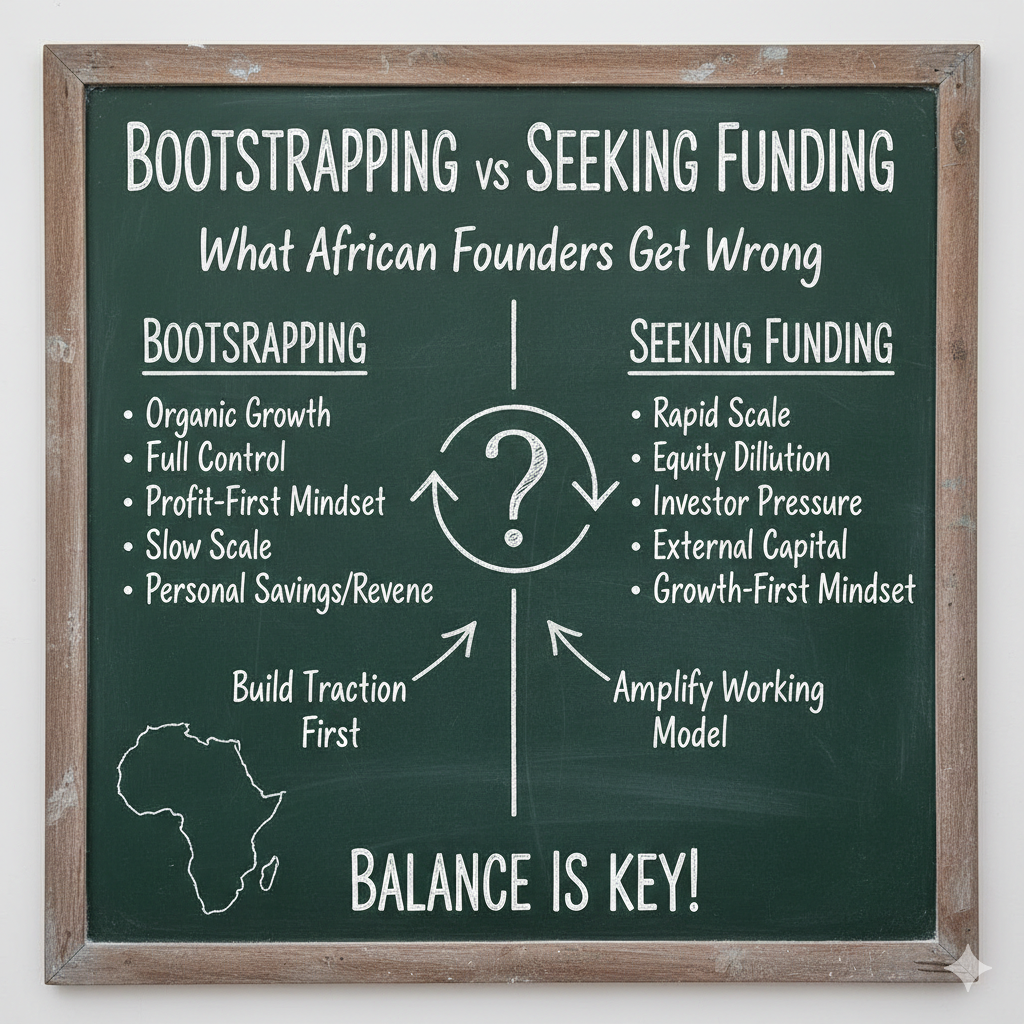
The “bootstrapping vs. funding” debate isn’t a simple choice between “slow and steady” and “fast and scalable.” It’s a strategic decision with profound implications for your ownership, your company culture, and your very survival. Let’s dismantle what African founders are getting wrong.
The “Funding-First” Delusion
The ecosystem is flooded with capital-ready narratives. Success is measured by “amount raised,” not “value created.” This creates a perverse incentive for founders to build a company designed for investors, not for customers.
Real Background Example: Consider a fintech startup in Nigeria that raised $1.5M seed in 2024 with a brilliant pitch about “banking the unbanked.” The pressure to deploy capital and show hyper-growth forced them into expensive above-the-line marketing (TV, billboards) and a 50-person team before their product was truly stable. Their burn rate was $120k/month. When their user acquisition costs (CAC) proved unsustainable and a subsequent round fell through, they folded in 8 months. Across town, a competitor offering a simpler agency banking solution bootstrapped, grew slowly on commissions, and bought the failed startup’s best assets for pennies on the dollar. They mistook funding for validation.
The Hidden Cost of “Dumb Money”
Not all capital is created equal. In Africa’s nascent ecosystem, the line between smart and dumb money is often blurred.
- Dumb Money: Comes with onerous terms, demands control, pushes for a Silicon Valley-style growth-at-all-costs model, and doesn’t understand local market nuances.
- Smart Money: Comes with relevant networks, operational expertise in African markets, and patient capital expectations.
Many first-time founders, desperate for a cheque, sign term sheets that give them 12-18 months of runway but shackle them with unrealistic growth targets. They go from building a business to playing a high-stakes game of “hit the KPIs or die.” The business model bends, corners are cut, and the original vision is lost.
The Bootstrap Advantage: Building on Your Own Terms
Bootstrapping isn’t just about lack of funds; it’s a powerful strategic choice. It forces a discipline that funded competitors often lack.
- Customer Dictatorship, Not Investor Democracy: When your survival depends on the next sale, you listen to your customers obsessively. Your product roadmap is shaped by market demand, not a board’s desire for a “pivot to AI.”
- Frugality as a Feature: Bootstrapped founders learn to do more with less. They negotiate harder, they hire more carefully, and they build efficient systems. This operational muscle becomes a massive competitive advantage later.
- Proof, Not Pitch: A bootstrapped business with 1,000 paying customers is worth more than a funded one with 10,000 free users. You own your data, your traction is undeniable, and you approach later funding rounds from a position of immense strength.
Case in Point: Look at the journey of SafeBoda in its early years. Before the big funding rounds and international expansion, they spent years bootstrapping and perfecting their unit economics in Kampala. They understood their driver-partners and passengers intimately because they had to. While they later faced scaling challenges, their initial strength came from that bootstrapped foundation. More recently, hundreds of “solopreneur” SaaS founders across Kenya and South Africa are building profitable, small-scale B2B software companies, never taking a dime of outside money, and living very well. They are the silent, successful majority.
The Trap of the “Zombie Unicorn”
When funded startups fail to achieve escape velocity, they become “zombies”: companies propped up by venture debt or bridge rounds, unable to grow but too proud to shut down or sell. They burn through millions, achieve nothing, and often miss the opportunity to build a modest, profitable business.
This is the worst of both worlds. You’ve given up equity, you’re beholden to investors, and you have nothing to show for it. Bootstrapped companies rarely become zombies. If the market isn’t there, they either pivot or shut down quickly, freeing the founder to start again.
The Middle Path: Strategic Funding
The goal shouldn’t be to avoid funding at all costs, but to earn the right to raise it. Funding is rocket fuel. You only need it after you’ve built a rocket that works.
A Decision Framework for African Founders:
- The “Lifestyle or Exit” Question: Do you want to build a profitable company you own for decades, or do you want to build a high-growth asset to sell or take public? Both are valid, but they dictate the path.
- The Capital Intensity Test: Does your business need massive upfront capital to operate? (e.g., hardware manufacturing, biotech). Or can you start with a laptop and an internet connection? (e.g., SaaS, agency, marketplace). If it’s the latter, bootstrap first.
- The Timing Truth: Don’t raise money when you’re desperate. Raise money when you have traction and don’t need it. That’s when you get the best terms and the smartest partners.
- The “Can I Get One Paying Customer?” Test: If you can’t convince one stranger to pay for your solution without funding, you won’t convince 10,000 with it. Funding amplifies a working model; it doesn’t create one from scratch.
Actionable Steps: The Capital-Efficient Founder’s Playbook
Instead of spending 6 months on a pitch deck, spend it on this:
- Launch a “Micro-SaaS” Version: Can you solve the core problem with a stripped-down, manual version? Use tools like Paystack or Flutterwave to accept payments immediately.
- Master Your Unit Economics: Know exactly how much it costs to acquire a customer (CAC) and how much profit they generate over their lifetime (LTV). If LTV is less than CAC, funding will only accelerate your bankruptcy.
- Embrace “Community Capital”: Before seeking institutional money, tap into your network. Can customers prepay for a year? Can suppliers offer better terms? This is non-dilutive, patient capital.
- Build a Public Track Record: Share your revenue numbers (even if small), your learnings, and your challenges on LinkedIn or X. This builds the “personal brand” that attracts both customers and the right investors later.
Final Thought: Own Your Destiny
The African tech ecosystem is maturing. The era of celebrating “unicorns” is giving way to a healthier appreciation for “zebras”: profitable, sustainable, and resilient companies that build real solutions.
The next wave of African success stories won’t be built on massive, unproven funding rounds. They will be built by founders who understood that control is more valuable than cash, and that a profitable, small business is the best foundation for a large, valuable one.
Before you send that next pitch deck, ask yourself: Have I earned the right to raise this money?
About the Author

Ssenkima Ashiraf Founder & Marketing Director at BuzTip
Ssenkima Ashiraf is the Founder & Marketing Director at BuzTip, a platform helping African businesses acquire their first customers online. He has advised over 50 early-stage startups across the continent on go-to-market strategy and practical validation. He is a strong advocate for capital-efficient growth and founder control.
Published on 13 February 2026 | Updated with Q1 2026 funding data