Across WhatsApp groups, Telegram channels, and Twitter spaces dedicated to African tech, a well-intentioned but economically devastating belief has taken root. It sounds supportive. It feels logical. But economically, it is completely wrong.
This belief is quietly suffocating African startups before they have a chance to breathe.
The Myth We Need to Kill
In Lagos, a user opens a local fintech app to check their balance. They have spent 1,000 Naira on data to do so. In Nairobi, someone browses a Kenyan e-commerce marketplace for an hour. They have consumed 500 MB of their monthly bundle. In Kampala, a student uses a Ugandan ed-tech platform to access learning materials. They have purchased 2,000 UGX of data specifically to study.
In all three cases, these users share a common thought: “I’m supporting a local business. I’m helping a founder. I’m contributing to the ecosystem.”
It sounds supportive. It feels logical. But economically, it is completely wrong. And this misunderstanding, this dangerous monetization illusion, is creating a generation of African startups with users, engagement, traction, and absolutely no revenue.
Where the Confusion Comes From
To understand why this myth persists, we need to understand the African mobile experience. In most African countries, internet data is expensive relative to average income. According to the Alliance for Affordable Internet, the cost of 1GB of data in many Sub-Saharan African countries represents a significantly higher percentage of monthly income than in Europe or North America. When someone earning minimum wage spends money on data, it is a conscious financial decision, often a sacrifice.
This creates a psychological framework where connectivity itself is seen as a form of investment. The user thinks: “I paid for this data. I chose to use it on this app. Therefore, I am contributing to this app’s success.”
Human beings are wired to equate effort with value. When we expend effort, whether physical, mental, or financial, we naturally assume that effort creates value for the recipient. This is true in personal relationships. If you travel across town to visit a friend, your effort demonstrates care. If you spend money on a gift, your purchase supports a business. But digital economics do not work this way.
The user sees their journey: financial sacrifice in buying data, intentional choice in selecting a local app, time invested in using the app, and emotional support in wanting the founder to succeed. They connect these dots and conclude: “I am supporting this startup.”
The founder sees: active users growing monthly, engagement metrics rising, downloads increasing steadily, and community goodwill in positive comments and shares. They look at these numbers and think: “We have traction. Users love us. Monetization will come.”
Both are wrong.
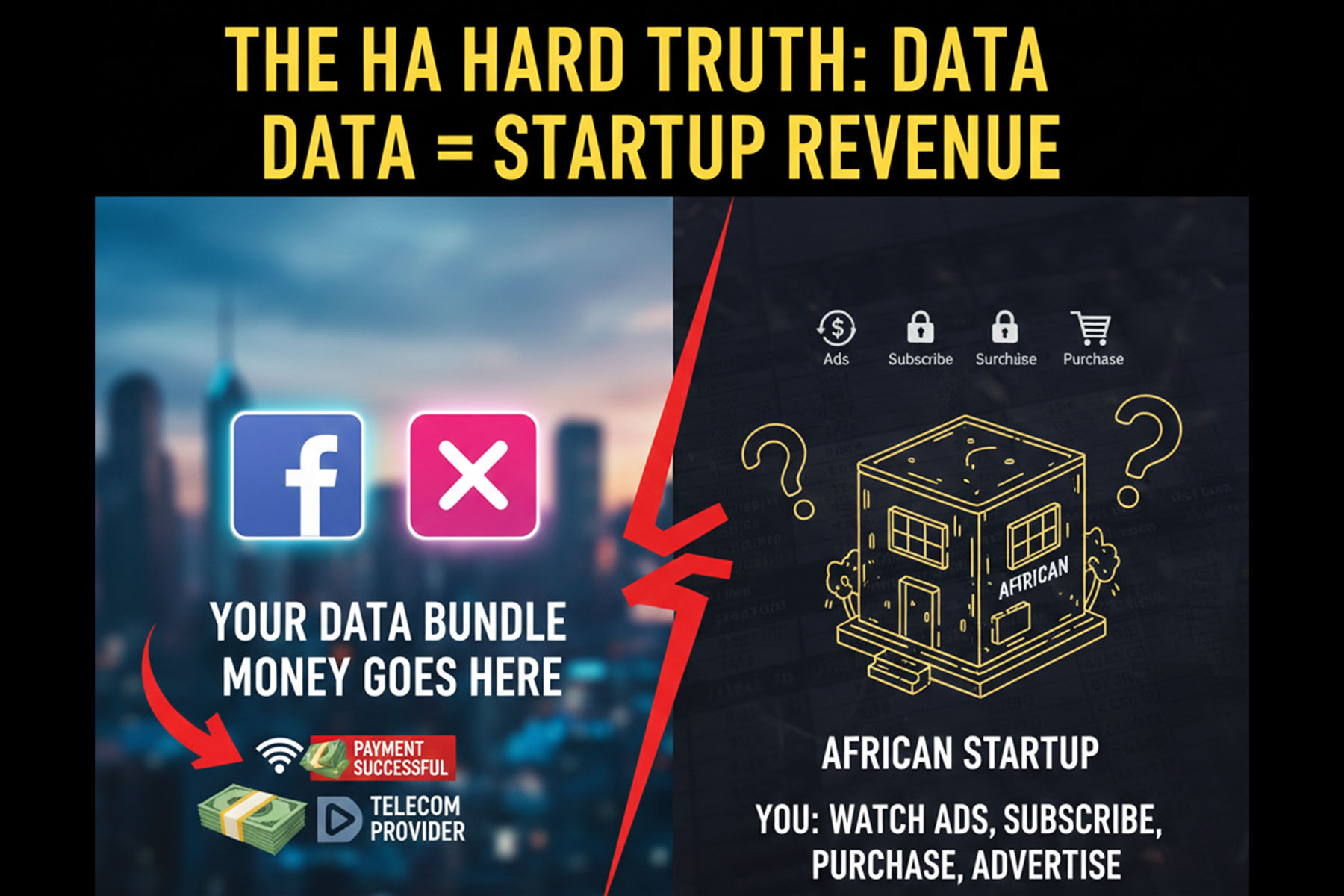
The Hard Truth: Startups Don’t Get Paid From Your Data Bundle
Let us follow the money. Where does your data payment actually go? When you purchase a data bundle from MTN, Safaricom, Airtel, Orange, or any other African telecom provider, that money flows into the telecom’s infrastructure. It pays for cell towers, fiber optic cables, satellite links, spectrum licenses, maintenance crews, customer service representatives, and executive salaries. It builds telecommunications infrastructure.
Not one cent of that money reaches the startup whose app you are using. The transaction is between you and your telecom provider. The startup is not a party to this transaction. They are not in the payment flow. They are not receiving a commission. They are not even notified that you spent data on their app.
To understand why this matters, we need to understand the actual business models of digital platforms. Consider global platforms you already know. When you use Facebook on your data bundle, Facebook earns nothing from your data payment. Facebook only earns money when you view advertisements in your feed, click on those advertisements, businesses pay Facebook to run those advertisements, you make purchases through Facebook Shops, or you subscribe to paid features in groups or pages.
X, formerly Twitter, earns when you view promoted tweets, subscribe to X Premium, or when businesses advertise. TikTok’s revenue comes from in-feed advertisements, branded effects and hashtag challenges, TikTok Shopping commissions, and LIVE gifting where users purchase coins. Netflix and Spotify earn through monthly subscriptions, advertising on ad-supported tiers, and content licensing to other platforms.
Notice what is missing from every single one of these business models? Data payments. Mobile bundles. Internet access fees. These platforms have built multibillion-dollar businesses without ever receiving a cent from your data plan. Because data payments are infrastructure costs, not content or platform revenues.
Your favorite African startup, whether it is a fintech app, an e-commerce marketplace, a content platform, or a SaaS tool, operates under the exact same economic rules. When you use their app on your data bundle, the telecom company earns revenue, the infrastructure providers earn revenue, and the device manufacturer potentially earned revenue when you bought the phone. But the startup earns absolutely nothing.
Usage is not revenue. Traffic is not income. Engagement is not earnings. This is the fundamental economic truth that too few African users understand.
Why This Mindset Is Dangerous
The belief that data spending equals support creates a cascade of negative consequences for African startups. When users believe they are already supporting a startup through their data spend, they develop psychological resistance to actual monetization attempts. The startup introduces a subscription and users think, “But I’m already supporting you with my data.” The app adds premium features and users wonder, “Why should I pay? I’m already paying to access your app.” In-app purchases are launched and users complain, “This is greedy. You should be grateful I use your platform.”
This resistance is not malicious. It stems from a genuine misunderstanding of how digital economics work. The user genuinely believes they have already contributed. Asking for money feels like double-dipping.
For founders, this mindset creates an even more dangerous problem: the illusion of sustainability. When user numbers grow, engagement metrics rise, and download counts increase, founders naturally feel validated. The signals look positive. The trajectory appears healthy. The community seems engaged. But revenue remains at zero. And because users are engaged and seemingly supportive, founders delay difficult conversations about monetization. They assume revenue will naturally follow growth. They believe that if they just keep building, the money will come.
It will not. Traffic without monetization is not a business. It is a hobby with high server costs.
This illusion also traps founders in a destructive relationship with investors. When user metrics look good but revenue is absent, founders are forced to raise capital just to survive. They pitch investors on traction and engagement and market opportunity. And because the African tech ecosystem is still developing sophisticated investment frameworks, some investors buy in. The founder raises a seed round based on user numbers. Then they raise a Series A based on continued growth. Then they raise a Series B and suddenly investors ask: “Where is the revenue?”
The founder, who has spent years building an audience that believes data spending equals support, now faces an impossible pivot. They must either introduce monetization to users who feel betrayed, raise more money at unfavorable terms, or shut down. This is not hypothetical. It is playing out across the continent right now.
The Monetization Reality in Africa
To build sustainable businesses, African founders must navigate a uniquely challenging monetization environment. The economic reality across much of Africa is that disposable income is severely constrained. According to World Bank data, a significant percentage of the continent’s population lives on less than $5.50 per day. When survival needs consume most income, digital services become luxuries. This creates a ceiling on what users can pay, regardless of how much they value a service.
Digital payment infrastructure, while growing rapidly, remains unevenly distributed. Mobile money dominates in East Africa but is less prevalent in other regions. Card penetration varies dramatically by country. Bank account ownership correlates strongly with urban residence and formal employment. This means that even when users want to pay, the infrastructure to accept payment may not reach them.
The global internet was built on free. Email is free. Search is free. Social media is free. YouTube is free. Wikipedia is free. This created a global expectation that digital services should not cost money. Users who have spent their entire online lives accessing world-class platforms without direct payment find it difficult to accept that smaller, local platforms need to charge.
Perhaps most frustrating for founders is the gap between emotional support and economic support. Users will share your app with friends, recommend you on Twitter, defend you in online arguments, write positive reviews, and send encouraging messages. But they will not pay for premium features, subscribe to paid tiers, make in-app purchases, click on advertisements, or refer paying customers. They support emotionally, not economically. And emotionally, they believe their data spending already counts as support.
What Real Support Looks Like
If you genuinely want to support an African founder, here is what actually builds sustainable businesses.
If a startup offers a paid tier, subscription, or premium version, purchase it. Even if you do not need all the features. Even if the free version works fine. Even if the price feels high relative to global alternatives. Why? Because recurring revenue is the lifeblood of sustainable startups. A single paying customer is worth more to a founder than hundreds of free users. Recurring revenue provides predictable income for planning, demonstrates product-market fit to investors, funds server costs and development, and reduces dependency on grants and investors. A $5 monthly subscription from 1,000 users creates $60,000 in annual recurring revenue. That is enough to hire a developer, pay for servers, and keep the lights on.
Word-of-mouth remains the most effective marketing channel for African startups. But not all referrals are equal. Referring friends who will also use the free version adds traffic but not revenue. Referring businesses, organizations, or individuals who will pay adds actual value. If you know a business that could benefit from a startup’s product, make the introduction. If you have colleagues who might need premium features, tell them why paying is worth it. If you are in a position to influence purchasing decisions within your organization, advocate for the startup.
For ad-supported platforms, business advertising is the primary revenue source. If you own a business, or know someone who does, consider advertising on local platforms. Even small advertising budgets of $50, $100, or $500 per month provide validation that the platform can attract paying advertisers. This proof point is invaluable when the startup approaches larger advertisers or investors.
If you have skills, connections, or assets that could help a startup grow, offer them strategically. This might include distribution partnerships to reach new users, content collaborations that drive engagement, technology integrations that enhance the product, or access to communities or networks. Strategic partnerships often create more value than direct payments, especially for early-stage startups.
Many African startups struggle not with product quality but with distribution. If you have access to physical or digital distribution channels, such as retail locations, community networks, email lists, or WhatsApp groups, consider how you might help the startup reach more potential paying customers. Distribution is often the hardest part of building a business. Help with distribution is genuine support.
If you cannot pay, refer, advertise, or partner, you can still provide value through feedback. But not all feedback is helpful. Vague feedback like “make it better” or “add more features” does not help. Specific, actionable feedback does: “I tried to pay but the payment gateway failed at step three,” or “I shared the app with five friends and three could not install it because of storage issues,” or “The loading time on 3G networks is too slow for my daily commute.” This kind of feedback helps founders improve the product for paying customers.
The Numbers Game: Why 1,000 Paying Users Beat 1 Million Free Users
To understand the economics of startups, consider two scenarios. Startup A has 1 million monthly active users. All use the free version. Zero pay. Revenue is zero dollars. Monthly server costs are $5,000. Monthly staff costs are $10,000. Monthly burn rate is $15,000. Runway depends entirely on investor funding.
Startup B has 1,000 monthly active users. All pay $10 per month. Revenue is $10,000. Monthly server costs are $500. Monthly staff costs are $2,000 as the founder works alone. Monthly profit is $7,500. Runway is infinite. No investor dependency.
Which startup is more sustainable? Which founder sleeps better at night? Which business can survive a funding winter? Startup B. Every time. This is the mathematics that too many founders and users ignore. Revenue concentration, a smaller number of paying users, creates more stability than massive free user bases.
Let us make this concrete with realistic African startup economics. Consider a typical cost structure. Cloud hosting might run $200 to $2,000 monthly depending on users. Developer salary ranges from $1,000 to $3,000. Marketing spends $500 to $5,000. Founder living expenses take $500 to $2,000. Miscellaneous costs add another $200 to $1,000. Total monthly burn lands somewhere between $2,400 and $13,000.
Now consider revenue scenarios. In a free with ads model with 100,000 monthly active users generating 500,000 ad impressions at a CPM of $0.50 typical for African audiences, monthly revenue is $250. Monthly loss ranges from $2,150 to $12,750. In a freemium model with 2 percent conversion on 100,000 users, 2,000 paying users at $5 per month generate $10,000 in revenue. Monthly profit or loss ranges from $7,600 profit to $3,000 loss depending on cost structure. In a premium only model with 1,000 paying users at $20 per month, revenue hits $20,000 with profit ranging from $7,000 to $17,600.
The math is clear. A small number of paying users creates more sustainable businesses than massive free audiences.
The Cultural Shift We Need
Africa does not have a talent problem. African developers, designers, and product managers compete with the best in the world. Africa does not have a creativity problem. African founders are solving problems that global founders cannot see. Africa does not have a market problem. The continent’s youthful, growing population represents one of the last great growth opportunities for digital services.
Africa has a monetization mindset problem.
Until users understand that using a startup is not supporting it, that paying for a startup is supporting it, that data bundles build telecom companies not startups, and that revenue builds businesses while traffic builds expenses, we will keep producing products that cannot survive.
This cultural shift requires education. Founders must explicitly teach their users about startup economics. This means blog posts explaining how the business works, in-app messages about the cost of running the service, transparent discussions about why monetization is necessary, and community forums where users can ask questions about pricing. Users are not economists. They do not automatically understand the difference between data payments and platform revenue. It is the founder’s job to explain it.
Tech media in Africa also has a responsibility. When journalists write about startups, they should ask questions about revenue, not just users. They should highlight sustainable business models, not just funding rounds. They should educate readers about what makes a startup viable. Every article that celebrates user growth without questioning revenue perpetuates the dangerous illusion.
Investors must also change their behavior. Funding user growth without clear monetization paths creates dependency, not sustainability. Investors who write checks based on vanity metrics, such as downloads, active users, and engagement, are part of the problem. The most valuable thing investors can do is ask hard questions about revenue from day one. Not after the Series A. Not when growth stalls. From the very first conversation.
Real Stories: Founders Who Learned the Hard Way
To make this real, consider these stories based on real African founders.
Kwame built a personal finance app for Ghanaian users. It helped people track spending, set budgets, and save money. Within two years, he had 500,000 registered users. Engagement was strong. Reviews were glowing. Users constantly messaged him saying how much the app helped them. Kwame tried to monetize through premium features, including advanced analytics, personalized recommendations, and priority support. He priced it at $2 per month, less than the cost of a single data bundle. Conversion rate was 0.3 percent. About 1,500 paying users. Revenue was $3,000 per month. His monthly costs were $15,000. Kwame spent two years chasing investors, raising small bridges, and slowly burning out. Eventually, he shut down. His users flooded social media with messages of sadness. “We loved your app,” they said. “Why are you closing?” None of them had paid.
Amina built a platform for African writers to publish and monetize their work. Writers loved it. Readers loved it. The platform hosted some of the continent’s best emerging talent. Amina’s monetization strategy was reader subscriptions at $5 per month for unlimited access to all content. She calculated that if just 1 percent of her monthly readers subscribed, she would be profitable. She had 200,000 monthly readers. One percent would be 2,000 subscribers. Revenue would be $10,000 per month. Costs were $8,000 per month. Profit would be $2,000. Actual subscribers were 342. Revenue was $1,710. Loss was $6,290 per month. Readers shared articles. They recommended the platform to friends. They praised the writers on Twitter. But they would not pay. Amina now works as a product manager for a European tech company. Her platform is archived on a hard drive.
David built a SaaS tool for African small businesses to manage inventory and sales. It solved a real problem, as businesses were losing money due to poor inventory tracking. He priced it at $29 per month, comparable to global alternatives but adjusted for local markets. He spent six months building. He spent another six months acquiring users through direct sales, partnerships, and content marketing. After one year, he had 47 paying customers. Revenue was $1,363 per month. Costs were $4,000 per month. David’s investors pushed him to raise more money and go big. They wanted millions of users. They wanted freemium. They wanted growth at all costs. David resisted. He believed in revenue from day one. He believed in building a business, not a user base. Three years later, David has 847 paying customers. Revenue is $24,563 per month. Costs are $18,000 per month. Profit is $6,563 per month. He has never raised venture capital. He owns 100 percent of his company. His growth is slower than the venture-backed competitors who raised millions and burned through it. But he is still here. Most of them are not.
What African Founders Must Do Differently
Given this reality, what should African founders do?
The biggest mistake founders make is delaying monetization. They want to build an audience first, then figure out revenue later. This is backwards. Users who never pay become habituated to free. They develop an expectation that your service costs nothing. When you eventually introduce payments, they feel betrayed. Charge from day one. Even if it is a small amount. Even if most users do not pay. Establish the expectation that your service has value and value costs money.
When you design features, prioritize what paying users need. When you make product decisions, optimize for the experience of customers, not browsers. When you measure success, track revenue, not just users. This does not mean ignoring free users. Free users can become paying users. Free users provide feedback and referrals. Free users generate network effects. But free users are not your customers. They are your leads. Treat them accordingly.
Every interaction with users is an opportunity to educate them about your business model. When you send emails, explain why you charge. When you post on social media, share the economics of running the service. When users complain about pricing, explain what it costs to keep the lights on. Some users will never understand. Some will always believe their data spend should count. That is okay. You are not trying to convince everyone. You are trying to build a community of users who genuinely understand and support what you are building.
Do not rely on a single monetization method. Combine subscriptions for regular users, pay-per-use for occasional users, advertising for users who will not pay, enterprise licenses for businesses, API access for developers, and consulting for clients who need custom solutions. Multiple revenue streams create resilience. If one stream underperforms, others can compensate.
Before you raise money, before you scale, before you hire a team, understand your unit economics. How much does it cost to acquire a paying customer? How much revenue does that customer generate? How long do they stay? What is their lifetime value? What is your gross margin? If the numbers do not work with 1,000 customers, they will not work with 1 million. Scale amplifies unit economics. It does not fix them.
Venture capital has created a global culture of growth at all costs. Raise money. Spend money. Grow users. Raise more money. Repeat. This model works for a tiny fraction of startups that achieve escape velocity. For everyone else, it creates dependency and destruction. Consider alternative models: bootstrapping with revenue, revenue-based financing, small grants that do not require hypergrowth, community funding from users, and strategic partnerships with established businesses. The goal is not to raise the most money. The goal is to build a sustainable business that serves customers for the long term.
What Users Must Understand
If you are a user of African startups, here is what you need to know.
When you spend money on data to use an app, you are paying your telecom provider. You are not paying the startup. The startup receives nothing from this transaction. Nothing.
Every free user costs the startup money. Server resources. Bandwidth. Support time. Development effort. When you use a free service, you are not helping. You are costing the founder money.
The only way to economically support a startup is to pay for its products or services. Subscription fees. In-app purchases. Premium features. Advertising if you are a business. These are the things that keep startups alive.
You might think your individual payment does not matter. It does. A $5 monthly subscription from 1,000 users is $60,000 per year. That pays for servers, salaries, and sustainability. If every user who genuinely valued a startup paid just a small amount, most African startups would be profitable.
If you cannot pay, you can still help. Refer people who can pay. Provide useful feedback. Share the startup with potential partners. Write reviews. Engage with content. But understand that these actions, while helpful, do not replace revenue.
The Role of Government and Policy
Governments across Africa also have a role to play in creating sustainable tech ecosystems.
High data costs create the psychological framework where users believe their data spend is significant. If data were cheaper, users might be more willing to pay for services directly. Governments can reduce data costs through infrastructure investment, spectrum allocation policies, competition enforcement, and tax policies that do not penalize connectivity.
Many users who want to pay cannot due to payment infrastructure gaps. Governments can support mobile money interoperability, bank account access for underserved populations, reduced transaction taxes on small payments, and consumer protection frameworks that build trust.
Government education campaigns can help citizens understand digital economics. Just as citizens are taught about saving, investing, and financial literacy, they can be taught about supporting local digital businesses.
Government procurement of local tech services sends a powerful signal. When governments pay for local software, they provide revenue to startups, validate local solutions, create reference customers, and demonstrate that local tech has value.
The Global Context: This Is Not Unique to Africa
It is important to understand that this challenge is not unique to Africa. The free culture of the internet is global. Users everywhere struggle with the expectation that digital services should cost nothing. What makes Africa different is the economic context. When disposable income is limited and data costs are high, the gap between user expectations and business reality becomes a chasm. But the solution is the same everywhere: education, direct monetization, and a cultural shift toward valuing digital services.
The Way Forward
We stand at a critical moment for African tech. The ecosystem has never had more talented founders building world-class products, users adopting digital services at unprecedented rates, investor interest in African opportunities, and global attention on the continent’s potential. But this moment will be wasted if we do not solve the monetization challenge.
For founders, build for revenue from day one. Charge early. Educate constantly. Focus on unit economics. Resist the growth-at-all-costs trap. Remember that a business with 1,000 paying customers is more valuable than a product with 1 million free users.
For users, understand that data is not payment. Recognize that free usage costs founders money. Pay when you can. Refer paying customers when you cannot. Support economically, not just emotionally.
For investors, ask about revenue before users. Fund sustainable models, not just growth stories. Provide guidance on monetization, not just scale. Remember that your job is to help build businesses, not just portfolios.
For media, educate readers about startup economics. Highlight revenue models, not just funding. Ask hard questions about sustainability. Celebrate profitable businesses, not just well-funded ones.
For governments, reduce data costs. Support payment infrastructure. Educate citizens. Procure locally. Create an environment where digital businesses can thrive without depending entirely on foreign capital.
The Bottom Line
Data bundles build telecom companies. Revenue builds startups. This is not complicated. It is not controversial. It is not debatable. It is economics.
Every time you use an African startup without paying, you are costing that founder money. Every time you believe your data spend is support, you are perpetuating a dangerous illusion. Every time you choose free over paid, you are contributing to the ecosystem’s instability.
If we want African innovation to survive, we must separate emotional support from economic support. If we want African founders to build sustainable businesses, we must pay for the value they create. If we want the African tech ecosystem to fulfill its immense potential, we must kill the dangerous monetization illusion once and for all.
Because founders cannot pay servers with “I’m using your app.”
About the Author

Ssenkima Ashiraf is the Founder and Marketing Director at BuzTip, a platform helping African businesses acquire their first customers online. He has advised over fifty early-stage startups across the continent on go-to-market strategy and has personally navigated the challenges of building a business with limited resources in fragmented markets.
Ashiraf is a strong advocate for capital-efficient growth, founder control, and revenue-first business models. He believes that the next wave of African tech success stories will be built not on massive funding rounds, but on sustainable revenue from users who understand the value of what they are receiving.
He writes regularly about startup strategy, African tech ecosystems, and the intersection of culture and commerce in emerging markets.
You can reach him at [email protected] or follow his thoughts on startup strategy and African tech on Twitter.
Join the Conversation
This article is the beginning of a conversation, not the end. If you are a founder struggling with monetization, a user who wants to support local startups, or an investor thinking about these issues, we want to hear from you.
Share this article with someone who needs to read it. Comment on social media using #SupportAfricanStartups. Email us with your thoughts, experiences, and questions. Subscribe to BuzTip for more insights on building sustainable African businesses.
Together, we can kill the dangerous monetization illusion and build an African tech ecosystem that truly serves its users, its founders, and its communities.
Published on 24 February 2026
© 2026 BuzTip. All rights reserved. This article may be shared with attribution but may not be reproduced in full without permission.