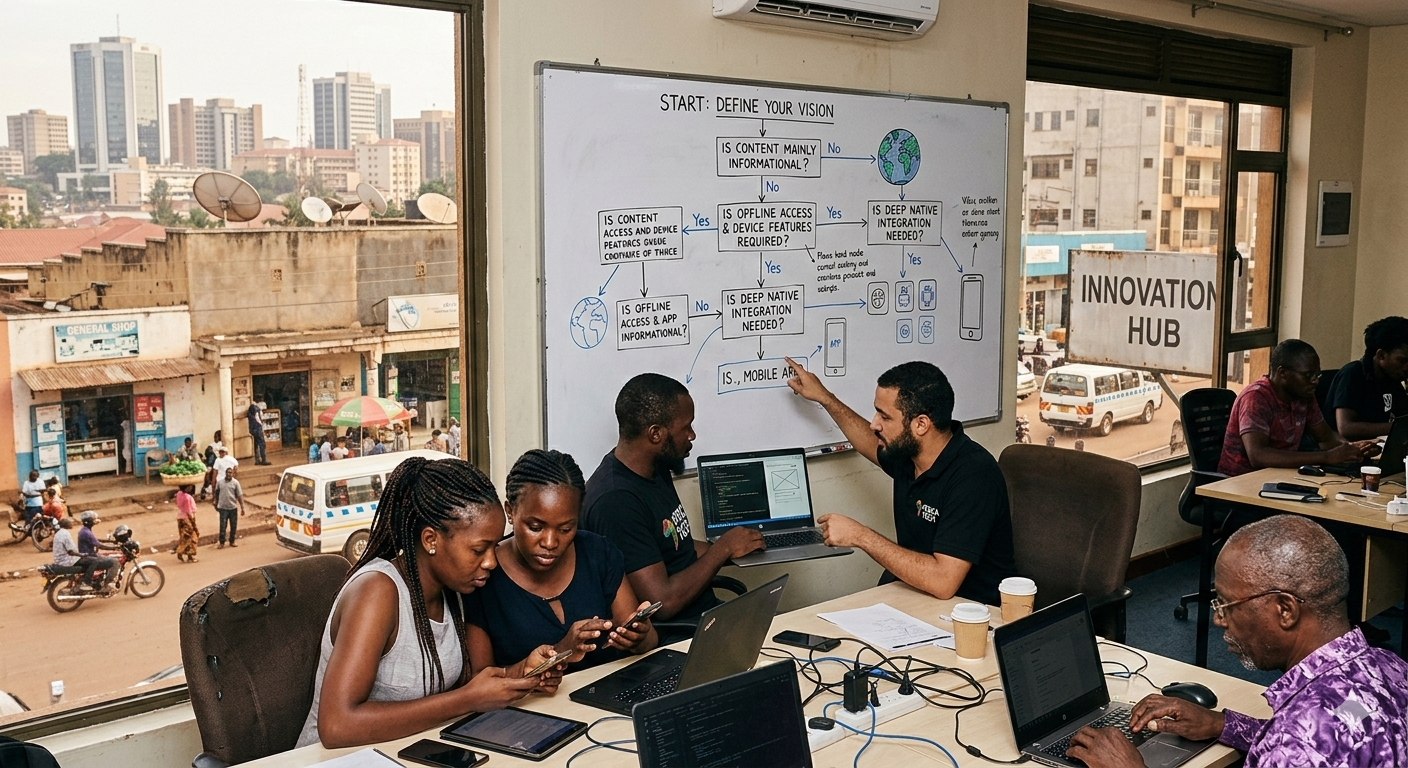
Website vs Web App vs Mobile App in Africa: What Your Business Actually Needs in 2026
Most African founders waste money building the wrong digital product first. They copy Silicon Valley without questioning whether the assumptions that work in San Francisco apply to Lagos, Nairobi, or Kampala. They rush to build mobile apps because that is what they read about in tech blogs and see on Product Hunt. They spend thousands of dollars on user interface design before validating whether anyone actually needs what they are building. But digital strategy in Africa must match the actual conditions on the ground. Internet penetration varies dramatically between capitals and rural areas. Device type dominance matters because many users still access the internet on low-end Android phones with limited storage. Data cost realities mean that users think twice before downloading an app or streaming high-resolution content. Payment behavior differs across regions, with mobile money dominating in some countries while card payments lead in others. Operational models must account for infrastructure gaps that founders in more developed markets never encounter. This guide breaks down what your business actually needs and what it does not, helping you avoid costly mistakes before they happen.
When Your Business Needs a Website
Websites are best for law firms, construction companies, NGOs, schools, real estate agencies, exporters, consultants, and media platforms. These businesses share a common characteristic: their customers need to find them, verify their legitimacy, and make contact before any transaction occurs. A well-designed website builds trust in ways that a social media page alone cannot match. It shows potential clients that you are serious about your business and willing to invest in your professional presentation. It helps you rank on Google when people search for services in your area, creating organic discovery that continues working twenty-four hours a day without ongoing advertising spend. It works on all devices, from the latest iPhone to a budget Android phone with a small screen and slow processor. It is cheaper to maintain than any other digital option, requiring only hosting fees and occasional content updates rather than ongoing development work.
In many African markets, customers Google you before trusting you. This behavior is so consistent that failing to appear in search results is effectively invisible to your potential market. When a small business owner in Kampala needs a lawyer for a contract dispute, they ask for recommendations and then search for those names online. When a school principal in Nairobi needs new desks, they search for furniture suppliers and compare the websites they find. When a family in Lagos needs a real estate agent to help them find a new home, they visit agency websites to see current listings before making any phone calls. If your business depends on being discovered by new customers, establishing credibility with skeptical clients, or generating contact inquiries that convert into sales, you need to start with a website. A simple one-page site with your services, contact information, client testimonials, and perhaps a portfolio of past work is often enough to generate leads before you ever think about building a mobile application. The website validates your existence and gives potential customers the confidence to reach out.
When You Need a Web App
Web applications are best for SaaS startups, inventory systems, school management tools, accounting software, internal business tools, and dashboards. These are situations where users need to log in, where data is being processed and stored, and where the primary interaction happens on larger screens. A web app lives in the browser but functions like software, allowing users to perform complex tasks, manage information, and generate reports without installing anything on their devices. This makes it accessible from any computer with an internet connection, which is perfect for business environments where employees may share devices or work from multiple locations.
In Africa, many companies operate from offices with shared computers rather than assigning individual devices to each employee. A web app works perfectly in this environment because staff can log in from any machine and access their work. Desktop-heavy environments are still the norm for administrative work, with employees spending their days in front of computers rather than on mobile devices. Moderate internet connectivity in urban areas is sufficient for web apps, which can be designed to work efficiently even on slower connections by minimizing data transfer and optimizing performance. For example, a logistics company in Nairobi might use a web-based dashboard to track its fleet, manage orders, generate invoices, and monitor driver performance. The entire operations team accesses it from office desktops, dispatchers use it to coordinate deliveries, and management reviews reports through the same interface. No mobile app is required for the core operations because the work happens at desks with computers. The web app handles authentication, data processing, and business logic while remaining accessible and maintainable.
When You Need a Desktop App
Desktop applications are best for point of sale systems, warehouses, factories, rural schools, and clinics with unstable internet. These environments have specific needs that web browsers cannot always meet. Desktop apps run directly on the computer’s operating system, giving them direct access to hardware like receipt printers, barcode scanners, and cash drawers. They can continue functioning perfectly when the internet goes down, storing data locally and synchronizing later when connectivity returns. They offer speed advantages because everything runs on the local machine without waiting for server responses or network transfers.
Desktop apps are powerful when internet is unreliable, which remains a reality in many parts of Africa outside major city centers. When speed is critical, such as during peak checkout times in a busy supermarket, desktop apps deliver instant responses that web apps sometimes cannot match. When offline functionality is required, such as in a rural clinic that needs to access patient records regardless of network availability, desktop apps provide the reliability that healthcare demands. Think of a rural pharmacy in Uganda using a desktop application to manage its inventory and process sales. The app works perfectly even when the internet is down, allowing the pharmacist to serve customers, track stock levels, and record transactions. When a connection becomes available later, the app synchronizes its data with the cloud for backup and reporting purposes. For most modern startups, however, a desktop-first approach is no longer the primary strategy. The trend toward web and mobile applications reflects changing user expectations and improving infrastructure. But for specific use cases in traditional industries and remote locations, desktop apps remain the most practical solution.
When You Actually Need a Mobile App
This is where most African founders make their biggest mistakes. They assume that a mobile app is the default choice for any digital product, when in reality mobile apps are the right choice only for specific situations. You need a mobile app if you are building a business to consumer product that requires daily engagement and wants to live on the user’s home screen. You need a mobile app if push notifications are central to your engagement strategy, allowing you to reach users even when they are not actively using your service. You need a mobile app if GPS or camera functionality is core to your product, because web browsers have limited access to device hardware for security reasons. You need a mobile app if you are in fintech, delivery, ride hailing, or other categories where mobile is the primary way customers interact with your service.
Examples of businesses that genuinely need mobile apps include ride hailing platforms where passengers need to request rides from anywhere at any time. They include e commerce apps where users browse products during commutes and want a smooth shopping experience optimized for small screens. They include mobile wallets where users need to check balances, transfer money, and pay bills while away from their computers. They include delivery services where customers track their orders in real time and receive updates when drivers approach. These use cases demand the capabilities that only mobile apps can provide.
But you must remember several African realities before committing to mobile development. Android dominates the market with over ninety percent market share in most countries, meaning iOS development is often a secondary concern. Data is expensive relative to income, so users are reluctant to download large apps or stream high quality content over cellular connections. Storage space is limited on budget devices, with many users constantly managing space by deleting apps they do not use daily. If users will not open your app at least a few times per week, you probably do not need one yet. A mobile optimized website that works well in browsers can serve your needs better while avoiding the friction of app store downloads and the ongoing cost of maintaining native codebases.
Infrastructure Decision Table
| Business Type | Website | Web App | Desktop App | Mobile App |
|---|---|---|---|---|
| Law Firm | Essential | Not needed | Not needed | Not needed |
| School / University | Essential | For portals and student management | Optional for computer labs | Not needed for students |
| Retail POS (Single Store) | Simple informational site | Not needed | Recommended for daily operations | Not needed |
| Retail Chain (Multi-Store) | Essential for brand presence | For headquarters management | For individual store operations | Optional for loyalty programs |
| Fintech / Mobile Money | Informational site required | For admin dashboards and reporting | Not needed | Essential for customer transactions |
| SaaS Startup (B2B) | Marketing site required | Core product delivered here | Not needed | Optional for mobile access |
| Media / Blog | Essential for content | Not needed | Not needed | Optional for app distribution |
| Logistics / Trucking | Essential for credibility | For dispatching and fleet management | Optional for offline warehouse use | For driver communication and tracking |
| Agriculture (Farm Inputs) | Informational site | For distributor management | Not needed | Not needed for farmers |
| Construction Company | Essential for portfolio | For project management | Optional for site offices | Not needed |
| Clinic / Hospital | Essential for credibility | For patient records | For offline clinic operations | Optional for patient appointments |
| Restaurant / Food Business | Essential for menu and location | For online ordering system | For kitchen display and POS | For delivery tracking and offers |
The Founder Mistake in Africa
African founders do not fail because of bad ideas. The continent is full of brilliant concepts that address real problems and serve genuine needs. They fail because they build apps before achieving traction, spending months and thousands of dollars developing mobile applications for businesses that have not yet proven there is demand. They overspend on user interface design, hiring expensive agencies to create beautiful screenshots for investors while neglecting the backend infrastructure that actually delivers value. They ignore infrastructure economics, assuming that what works in London or New York will work in Accra or Lusaka without accounting for differences in connectivity, device capabilities, and user behavior. They copy foreign models blindly, building Uber clones and Airbnb copies without understanding that those businesses succeeded because they solved specific problems in specific contexts, not because their business models are universally applicable.
Your digital infrastructure must match your customer behavior, not the behavior of users in Silicon Valley. It must match your revenue model, because the economics of free apps supported by advertising do not work when your users cannot afford expensive data plans. It must match your operational reality, including how your team works, where your customers are located, and what infrastructure you can rely on. The businesses that succeed in Africa are not those with the most sophisticated technology. They are those with technology that fits the market, that users can actually access and afford, that solves real problems without creating new ones.
Recommended Learning Resources
To better understand the differences between websites, web apps, and mobile applications, these video resources provide valuable context. Watching them will help you see the bigger picture of digital infrastructure and why choosing the right foundation matters for your business.
1. How the Web Works (Beginner Friendly)
This beginner friendly video explains the basic infrastructure behind every website you visit. It covers what happens when someone types your URL into a browser, how servers deliver content to users around the world, and why some websites load quickly while others struggle. This understanding helps you appreciate why hosting quality and website optimization matter for user experience.
2. What Is a Web App?
This video provides clarity on the difference between static websites and interactive applications. It explains how web apps combine the accessibility of the web with the functionality of desktop software, allowing users to log in, manipulate data, and perform complex tasks entirely within their browsers. This helps you understand why web apps are often the right choice for business tools and SaaS products.
3. Mobile App vs Website Explained
A practical breakdown of the tradeoffs between mobile apps and websites. This video covers development costs, user experience differences, maintenance requirements, and the situations where each option makes sense. It is particularly valuable for founders trying to decide whether to build a mobile app or invest in a responsive website first.
4. SaaS Architecture Basics
This video introduces the concepts behind software as a service, explaining how modern businesses build scalable products that serve thousands of users without collapsing under the load. It covers database design, API architecture, and the infrastructure decisions that determine whether your product can grow successfully.
Why These Videos Matter
Understanding the fundamentals before you build helps you ask better questions, evaluate developer proposals more effectively, and make strategic decisions aligned with your actual business needs rather than industry hype. These resources represent hours of viewing that will save you months of costly mistakes.
Final Advice for African Founders
Start small. Build the simplest version of your product that delivers value to customers, then add features based on what they actually use and request. Build what the market demands, not what you imagine they want, by talking to potential customers before writing any code and testing your assumptions with real users. Upgrade infrastructure as traction grows, adding complexity and capability only after you have proven that people will pay for what you offer. Not every business needs a mobile app, despite what you read in tech media and hear at startup events. But every serious business needs digital strategy that aligns with their market, their customers, and their operational reality. BuzTip exists to help founders build smart, not expensive, by focusing on what actually works rather than what looks impressive in pitch decks.
About the Author

Ssenkima Ashiraf is the Founder and Marketing Director at BuzTip, a platform helping African businesses acquire their first customers online. He has written extensively on digital sustainability, technology economics, and the intersection of community values with business models. His work focuses on helping founders understand the real costs and strategic choices behind the digital products they build.
Ashiraf is a strong advocate for pragmatic, infrastructure-aware digital strategies that prioritize traction over trends. He believes that smart, sustainable growth comes from matching technology choices to real customer behavior and operational realities rather than copying what works elsewhere. He writes regularly about startup strategy, African tech ecosystems, and the economics of digital services in emerging markets. You can reach him at [email protected] or follow his thoughts on technology and sustainability on Twitter.
Join the Conversation
This article is the beginning of a conversation, not the end. If you are a founder struggling with your digital strategy, a developer advising clients, or someone thinking about these issues, we want to hear from you.
Share this article with someone who needs to read it, whether they are just starting their entrepreneurial journey or have been building for years and need to reconsider their approach. Comment on social media using BuildSmartAfrica to connect with others thinking about these same questions. Email us with your thoughts, experiences, and questions about what has worked for you and what challenges you still face. Subscribe to BuzTip for more insights on building digital services that serve African markets effectively, delivered directly to your inbox.
Together, we can build a smarter, more sustainable digital future for African businesses, one smart decision at a time.
Published on 03 March 2026
Copyright 2026 BuzTip. All rights reserved. This article may be shared with attribution but may not be reproduced in full without permission.